I will leave the blog up for those who want to continue referring back to past posts, at least for the foreseeable future.
If you would like to contact me, feel free to email ben (at) better-boss.com. Thanks for reading!

Get a little better every week. Blog generally updated Monday
Actions to take: Avoid statements implying that you will never judge your employees' work. Be open about the fact that part of your job is about checking up on whether they are successfully meeting expectations. Also also be the type of manager who explicitly checks in with employees and coaches them to more effective performance. Accept that the role of manager is a complex one, and do both.
Do you check-in with your employees, or do you check-up on them?
The former is non-judgmental. It is about making sure they have everything they need to get their work done. It is about convincing them to be candid with you about their shortcomings so that you can effectively help them improve. The latter is judgmental. It is about telling your employees what you think of their work. It is about ensuring the job is getting done to satisfactory standards.
This is the point where your inspirational management blogs will describe the horrors of being a check-up boss. "Foster an environment where your employees never feel criticized. They'll never fear any kind of reprisal or judgment about their work, so they will be far more likely to come to you for advice or to show you where they are having trouble. Stop the check-UP and focus on the check-IN!"
That is an over-simplification that will lead to disaster.
Managers are judging our employees' work. That is explicitly part of the job. If a boss tries to convince employees that all conversations are just check-in conversations, they are setting themselves up to betray their employees. The fallout will be enormous. Imagine it. Over and over, your boss says things to convince you that they're just here to help. They have no ulterior motive—they absolutely won't judge you in any way.
That boss has painted themselves into a corner. Eventually, they will have to do some kind of check-up. Maybe a deadline is past; maybe the employee is doing sub-par work in some area; or maybe it's just time for annual employee evaluations. The better they did at convincing employees that they're "just here to check in," the more two-faced they will seem when it comes to make some kind of judgment about the employee's work.
Instead, be honest with yourself and with your team. "As your boss, I'm here to help, and I am here to keep you on the right path. I hope that you will come to me for help on any and all of your work issues. I would like to offer my perspective and give you advice whenever you are wondering how to proceed with something. I am also here to check in on your work. Part of my job is making sure we all get our work done, which means I'll need to probe at your progress occasionally. The times when I need to do that are usually times when things aren't going perfectly for you, so it might be a sensitive subject. I will do my best to handle those conversations with grace. But there is no point in pretending that I'm only a guidance counselor for your work."
This check-in vs check-up dichotomy relates to two fundamental and much more talked-about concepts: coaching vs feedback. If your employee is consistently underperforming, feedback conversations and coaching conversations serve different purposes, but they are both important. For instance, they might consistently fail to meet deadlines. They need to know your opinion on the issue. You need to check-up on their progress at fixing the issue and communicate your judgment of their work by giving feedback. A helpful boss will also coach their employees to better performance. They will have check-in conversations with a non-judgmental tone to collaborate on finding ways to improve.
If you successfully communicate to your employees that your job is about checking-up and checking-in, you can often have both of these conversations in the very same meeting.
The average boss tends to default to one or the other. Either they're always checking-up, thereby creating an authoritarian environment where their employees see them as unhelpful, judgmental, and useless. Or they are always checking-in, thereby creating an environment where their employees see them as a fake friend who says one thing but does another (because the job ultimately requires it). Better bosses recognize that managing people is a complex process. It requires us to be judge and mentor at the same time.
Actions to take: Think about personnel issues the same way you think about any other imperfection in the workplace. If it is big enough, do anything necessary to fix it. For everything else, do the cost-benefit analysis of whether it is worth fixing. Attempt to fix issues with a bit of feedback or conversation. However, stop yourself from overcommitting resources (your time and energy) to fixing problems that, ultimately, are not that important. When your organization disagrees with you about how big a problem is (by, for instance, preventing you from introducing disciplinary action), practice professional detachment by accepting this as just one more imperfect process.
This post will give you a tool for mentally dealing with the fact that, sometimes things don't end up the way you would like when it comes to personnel issues.
Before we talk about personnel issues, let's talk bout process issues for a moment. All work process are imperfect. Take something as simple as shelving books at a library. On the micro level, each shelver is getting better all the time. They catch onto little nuances about the shelving system and make their everyday work more efficient. Shelving also improves on the macro level. Libraries are constantly tweaking their cataloging system to make book location more intuitive and accessible. Organizations at every level of success in every industry continuously work toward improvement. Even excellent processes can be improved upon.
The reverse is true as well. Some subpar processes stay the same for years and years. I am positive that you can think of several processes that have obvious fixes or improvements that never got implemented. For me, it will always be the morning newspapers at one of the first libraries I worked for. Every morning, we prepped the newspapers before setting them out for the day. Included in that process, we stamped them with the library's name and logo to identify it as the property of the library. We stamped every section of every newspaper with this property mark.
In my eyes, this was a totally useless step. Theft had never been a problem, and we threw out old newspapers after a few months anyway. One stamp on the front, fine. But who is stealing the Arts and Fashion section of the local paper? I saw it as purely wasted time.
I wasn't considering transition costs back then. Yes, maybe it was wasted time, but it was a small amount of wasted time. Everyone was used to doing it this way. The effort it would take to convince everyone that theft was not going to be an issue would have been a huge hassle after years and years of saying theft is the reason we do this stamping. There's also the opportunity cost to think about. We're all busy all the time. If we spend time fixing this issue, what else might have we been doing with that time? Probably something more meaningful than eliminating a few minutes of stamping each morning.
As a boss, you need to recognize that personnel issues function in exactly the same way. Major problems need to be corrected, and it is your job to see those issues through to completion. But some issues are simply not worth the time and energy it would take. Your employee says discriminatory things to coworkers? You must do anything necessary to fix that problem. Your employee tends to chit-chat a little too long about weekend plans on Friday? Put a little energy into correcting it, but let it go eventually if it is an isolated issue.
This post is something of a spiritual successor to the previous two posts about the role of Human Resources. Sometimes, you will be convinced that a personnel issue is major. Major enough to consider termination. HR or the powers that be above you keep pulling you back. Every time things feel as though they are coming to a head, actions stall out. You're left with a problem employee that you believe needs to be let go. These are the times when it is the most important to think of personnel issues as process issues.
Think again of transition costs and opportunity costs. The transition cost of solving a personnel issue comes in the form of your time, energy, and frustration while trying to have productive feedback conversations with the employee (and, potentially, a bunch of side conversations with HR and your boss about the issue). Transition costs also come in the form of the employee's reaction, their resistance, their frustration, their being distracted from other work. The opportunity costs are all the other things you could be doing with that time. In terms of achieving outcomes, there is fair evidence that focusing your time and energy on high performers (i.e. accelerating "processes" that are already working) is more beneficial than focusing on poor performers (i.e. fixing "imperfect processes").
Do not get emotionally caught up in feeling the need to fix personnel issues. It is easy to do. Personnel issues are, well, personal. How often do we have major emotional reactions when the organization has some dumb, subpar process though? Yea, unnecessary paperwork is a waste of time, but are you having heated arguments or losing sleep over it? Probably not.
Managing people is important. But it is still just a job. Practice a little professional detachment, and convince yourself that a certain amount of imperfection in your workplace is acceptable.
If you push yourself to think about personnel issues as just another part of the process, you will have far more success coping with the frustration of unchecked problems. Yes, we want to always be improving. Yes, we must address any significant issues. Yes, we should see if most issues can be solved quickly with a little casual feedback. No, we are not capable of making absolutely every issue vanish. And that's okay.
As promised in The Role of HR - Part 1, this post will help you understand how to operate most effectively given that HR exists to minimize legal risk to the company.
The first step is to truly understand what that means for you. The fact that HR's underlying motivation is about legal risk has genuine pros and cons for every manager and every employee in the organization.
Pros:
I encourage you to think through more pros and cons. The more you actively think about the fact that HR exists to minimize risk, the more your will accept it. The more you accept it, the less frustrated you will be about it.
Here are a few more tips to add to your body of knowledge on this topic:
I want to take a moment to drive home the point that it is not HR's decision whether or not someone should be let go.
That decision rests somewhere in the chain of managerial command. This is something that many, many people misunderstand. I would venture to guess that even the majority of high-level managers/executives don't fully comprehend who is ultimately responsible for the termination decision.
It simply cannot be HR's decision. First, theirs is a support department. Team composition is an operational decision that is integral to the core process of the business. Support departments do not make operational decisions. Second, we mentioned the HR mantra "let's find a way to make sure this doesn't escalate further" in Part 1. If the termination decision is in the hands of HR, no one will ever get fired. There will always be something else to try before taking that step. Termination is the ultimate escalation of the issue, which is contrary to their mantra, contrary to their entire way of thinking about problem-solving.
If you find yourself in a situation where no one understands this fact, then I encourage you to remove termination from your managerial toolbox. Stop thinking about it as an option. If termination is truly in the hands of HR, then it will take an act of arson for anyone to get fired. You have other tools to encourage effective performance. Yes, you'll be less effective without access to this particular tool. But it will be worse if you try to reach for it and it isn't there.
Think of HR as the neurotically cautious parent. They are constantly telling you “I don’t know about that” when you want to stretch out and do something new. That is an important and valuable role. Imagine a camping trip comprised of individuals who all love to take risks and just go for it. Those people have a lot of fun, do a lot of interesting things, and have a pretty big risk of somebody breaking their arm before the trip is over. It would be valuable to have someone who is cautious holding you back from the most dangerous activities.
At the same time, if that person has too much power or influence, nothing ever happens. In our camping metaphor, you might not even be able to make s’mores because the cautious person is worried that fire might burn someone.
If you don’t delude yourself into thinking that HR is your friend, you will have a much friendlier relationship with them. You won’t feel betrayed when they do something that is in line with their interests and against yours. HR serves a purpose. It exists for a reason. Understand that reason, accept that reason, and work with that reason.
The real role of Human Resources is an open secret. Until you gain some political acumen, you are probably thinking about your HR department in the wrong light.
Early in a person's career, they will think of Human Resources as having two functions. The first is basically as a bureaucrat, someone to make sure all the paperwork gets completed and filed in the right place. The second function is as a complaint department. If your boss is doing something you don't like, or if somebody else is doing something you don't like and the boss won't fix it, you go to HR. Then, when HR listens politely but ultimately nothing changes, you get embittered. "HR isn't doing their jobs," you will think. This perspective is wrong, and the source of your bitterness is your own misunderstanding of HR, but we will get to that later.
New managers have similar misconceptions about Human Resources. They are on the other side of problems now. Just like employees, new managers assume that the purpose of HR is to help them with employee problems. The manager is trying to manage an employee with chronic issues, repeatedly going to HR for advice, trying their best to follow that advice. But, somehow, the problems are never quite bad enough for HR to let the manager fire the employee. This new boss's perspective is wrong in even more ways than the employee's above, but again, that's getting ahead of ourselves.
(Look at the irony, by the way. Both sides of an issue, the employee and the boss, think that HR is there to "deal with" the other party. Bosses, as employees themselves, really ought to recognize this logical impossibility and have the revelation that HR must not be there to serve them. But nobody seems to have that breakthough.)
Trying to learn about Human Resources through traditional means will only reinforce your misinformed viewpoint. Internet searches about the role of HR will give you webpages with titles like “The 7 Functions of HR” or “The 5 main areas of HR.” Those pages will all include some combination of the following: facilitate hiring, onboarding, and training; administer the performance appraisal process; ensure workforce engagement; payroll management; ensure compliance with laws and regulations; conduct disciplinary actions; maintain employee records; etc.
HR textbooks are the same. You'll get chapters on all of the above and on various legalities. However, the text only hints at the real purpose of HR, and only if you read between the lines. That is a list of activities HR does. That list is not HR's purpose.
Human Resources exists to minimize legal risk to the organization.
Whatever else they are doing, the underlying motivation will be to reduce the risk of a lawsuit. The main purpose of HR is not about helping the manager. The main purpose is not about helping the employee. It is not about developing the best, most effective workforce.
Many HR professionals would feel that this is reductive, that they care about a lot more than avoiding lawsuits. I am sure that is true for them on a personal level. Human Resource departments do indeed complete all the tasks listed above. However, it doesn't change the fact that their purpose is about legal risk.
Here is an analogy to management. The role of the manager is to make their employees more effective at their work. It is not about making employees happy. Every good manager wants to make employees happy, but they are delusional if they think employee happiness is the purpose of their job. Same with HR.
The institution of Human Resources, the conceptual underpinnings, will drive all HR actions toward whatever is most likely to avoid a lawsuit or other high-profile dispute resolution processes. Their number one priority is to make problems go away in the lowest-stakes way possible (notice I did not say "solve"). The mantra of a properly functioning HR department is, "Let's find a way to make sure this doesn't escalate further." While they are ensuring the paperwork gets filed, they are thinking about minimizing legal risk. While they are listening to employee complaints, they are thinking about minimizing legal risk. While they are helping a manager with disciplinary issues, they are thinking about minimizing legal risk.
That is their role. In Part 2 next week, we will explore the question, "What does the real role of HR imply about how I should operate as a manager?" In the meantime, I encourage you to think on that question yourself. Hint: the answer is not "get bitter and untrusting of every HR professional."
Better-boss.com advocates for casual, frequent performance feedback using the following formula: 1) ask if you can provide feedback; 2) provide feedback using the format "when you do X, it has Y impact"; 3) finish with a question asking them to change or an affirmation that they should keep it up. Feedback is short, simple, and can be about any work behavior. All posts about feedback assume this formula and strategy.
One of this blog's tenets of feedback is that feedback can be about any work behavior. When I discuss this with people who are new to the idea of frequent feedback, "any work behavior" is a common area of resistance. Surely, they argue, some things are simply expected. It would be BLANK to give feedback about such mundane things (fill in the blank with your choice: irrelevant, condescending, counter-productive, etc.).
When I am confronted with this point of view, I go through the usual explanations. The person may be picturing praise or punishment rather than feedback, which creates a completely different dynamic to the conversation. Part of the value of feedback is acknowledging that you as manager notice the employee's work, so there is value in mentioning the "obvious" things. Because feedback is about impacts, not just actions, some of the "obvious" things aren't so obvious after all.
I explain all these things. The easiest way to make the case, though, is to just show feedback in action. Here are 20 feedback examples. Judge for yourself whether they are worth giving to employees.
Actions to take: Rate interview candidates on a question-by-question basis. Train yourself and encourage others to focus on factual information from a candidate's answer rather than anything stylistic about their answers. Develop or encourage your organization to develop rating scale descriptions that give meaningful guidance on how to rate.
Most organizations do not have an effective method for deciding who to hire at the end of the interview process. There are a variety of reasons why, not least among them is the historical context. It has only been in the last 30 years or so that the introduction of behavioral economics as a field of study started to reveal human tendency for bias and inability to make fully rational decisions. Prior to that, decisions were based on the subjective impression of the hiring manager, and the entire process was built to facilitate their choice. While plenty of organizations have begun to make changes that correct for these errors, we still have a long way to go.
Organizations have made strides in terms of codifying the interview process to ensure that it is consistent across candidates. "Clever" interview questions that were popular in the early 2000's are being replaced with scientifically validated behavioral interview questions. Hiring panels are being trained on implicit bias issues.
One area where we still have a long way to go, however, is our process for making the final decision.
Imagine an instructor grading final exams for a university course. They read the student's entire exam, think about it for a while, maybe chat with others who have read the entire exam, and then decide holistically on a score out of 100. "This one feels like a 92 out of 100, that one feels like an 85 out of 100." That sort of thing.
Would anyone consider this to be a fair assessment of the student's skill? Of course not. It's absurd on its face. Yet this is how a great many hiring managers make their hiring choices. It's worse, actually. Using our exam analogy, it would be more along the lines of the professor reading all the exams before deciding on a score for any of them. We go through all of the interviews. Then, only at the end, do we try to make an assessment of who did best.
The best, fairest, and most effective way to rate interview candidates is the same as the best, fairest, and most effective way to rate a final exam: do it item by item, with a clear rubric and criteria for grading, intentionally leaving out anything that is not explicitly job related such as your "feel" of the candidate. Again, think about how angry you would be at a professor who moderated scores based on their "feel" of the student's knowledge. We should be just as incensed by managers who operate by gut, or instinct, or their impression, or whatever else you want to call it. Yet, somehow, "Wow, I got great vibes from them" is a totally acceptable thing to say on an interview panel.
When I say you need to rate your candidates "item by item," Here is exactly what I mean:
As dry and procedural as it sounds, simply adding up the scores and selecting the highest scoring person is the best method for choosing who to hire. Virtually every other process accommodates or even encourages the decision to be influenced by irrelevant (aka biased) information. The fact is, our rating process should be more about actively pushing away some sources of information, not about gathering as much information as possible. More information is not better information. As we have talked about, this is a hard pill for some bosses to swallow. Nevertheless, it is true.
We stick to the simplest process, rating each question one at a time, to safeguard our decision from as much irrelevant information as possible.
(To everyone saying "But what about the human touch?" By all means, ask all the questions you like about teamwork or conflict resolution or any other interpersonal skill. Then rate the answers, not your brief impression of the person.)
Some of you are saying, "My organization has a scale, so I guess we're fine." You are probably not fine. It is not enough to merely have a scale. You need to train your interview panelists and hiring managers on exactly how to rate.
If you just tell people, “Rate the candidate’s answer on a scale of 1 to 5,” you will get all sorts of variation in how people use the scale. "5" for one person might be "3" for another. Many people will never rate anyone a 1 because there is a vague unease with giving a person the lowest score. I've seen this happen even when the candidate didn't have an answer at all—the rater gave them a 2 because the candidate "tried."
There is a second, bigger problem the occurs when you don't train on rating. In our post on why most interview question fail, we talked about how some questions end up soliciting good-sounding-but-irrelevant information. We explained that these questions fail because they reward people who speak well in interviews rather than those who do well on the job. Untrained raters will fall into this trap even with well-designed interview questions. They will give high ratings to people who speak eloquently, even if those people ultimately say nothing of substance in their answer.
You need to train yourself and others to look for materially important details about how the candidate did the work. Watch the answer for factual information. What exactly was the candidate responsible for? How exactly did they proceed in their example? What factors did they consider in their decision-making process? Is the way they acted similar to how you would want them to act in your organization? That is what matters, not how well they strung together their words. When I train on this, I will show recordings of answers to interview questions: one where the speaker is very on-the-ball and well spoken, but ultimately gives little or no information about their work; one where the speaker muddles through the answer but has real content about how they performed some aspect of a job. Before being trained, people invariably rate the first video higher than the second.
Your organization should create meaningful descriptions of each score. Most rating systems give about this level of detail: "Rate 1 to 5, where one is a poor answer and 5 is an excellent answer." This doesn't guide interviewers in any meaningful way. People have different notions about "poor" and "excellent." Give clear criteria about what constitutes a 1, what constitutes a 2, etc. to prevent the inconsistency.
Truly going the extra mile, an organization would be best served to create these descriptions for each type of question you will be asking during the interview. For instance, here is a rating description for questions that probe a candidate's problem solving.

Take a look at the level of detail in this rating description. It is clear when the candidate must be given the lowest score. Even your kindest-hearted interviewers will be compelled to give that score when appropriate with this level of guidance on how to rate. Same thing on the other end. There are specific criteria that must be met before the highest rating can be given. Will there still be variation among the raters? Some, yes. But if that's true for this rating system, imagine how useless a basic "rate 1 to 5" scale is.
A set of rating descriptions like this will make your interviewers far better at their jobs. They will be listening for whether or not the candidate answer meets these criteria, which means they will focus on the content of the candidate's answers, the factual information that meets or fails to meet the criteria. Because they will be focused on relevant information, there will be less room for biased or irrelevant information to influence hiring decisions. In short, your organization will hire better.
In our article about managers' overconfidence in hiring instincts, the capstone advice was to "develop and adhere to hiring processes that are specifically crafted to minimize bias and fallibility in human decision-making." Hopefully this post will be a start on your journey to more effective rating practices.
Actions to take: Recognize when you are overinvested in the outcomes of work issues or decisions. Stop yourself from rash actions or rash communications on the matter. Take big-picture preventative measures such as having other passions, as well as more immediate measures such as consulting colleagues on the specific issue.
Have you ever been so sure you are right about something that you would move mountains to convince everyone?
One time, I was in a branch manager's meeting for a large library system when the chain of command announced a major change to our organizational structure. They were adding additional management positions to the branches. Great news, as I was directly supervising 25 people at the time. However, we weren't taking a traditional approach, like adding an assistant manager or department managers. Rather, the positions under the branch manager would supervise a cross section of the library—some shelvers, some desk workers, and some professional librarians each. As they explained, "It will be as though each supervisor has their own mini-library."
I spent the remainder of the meeting in something akin to an adrenaline panic. I needed to change their minds about this plan. If I could come up with the right explanation, then surely they would see the problems that this kind of structure will cause. As soon as the meeting ended, I rushed to my boss to try to express my concerns. (I had not yet learned that there's no point in questioning decisions that are finalized.) Naturally, she brushed me off. Lots to do after any manager's meeting but especially one with an announcement this big.
After work, I called some friends to vent and game plan my next steps. I couldn't sleep that night. At the next one-on-one with my boss, I laid out a comprehensive explanation of the problems with this kind of structure. I talked about how it would cause mass confusion about who was responsible for what, decision-making be knee-capped, etc. etc. etc. She listened patiently and delicately brushed me off once again. Later, I did the same thing with her boss. Eventually, I had a sit-down meeting with the executive director of the entire library system. Each person kindly and patiently brushed off my concerns.
That week, the problem consumed me. I was up late every night unable to sleep. It was all I thought about. It was all I talked about with my spouse. I needed to help my organization avoid the crisis that I had decided would inevitably occur if we went through with the decision.
The organization went through with the decision. Of course we did. We already had gone through with the decision by the time I first heard about it. My worry, my mental energy, my passion about this issue only caused problems. It was a huge distraction from my day-to-day work, and it was time I could have been using to figure out how to implement the change as effectively as possible. It was a huge distraction and time-sink for the chain of command above me.
There is such a thing as too much passion for your job. There are times when your level of emotional investment is a problem, not an asset. Here is what to do instead:
The dose makes the poison. Anything is toxic when you get too much of it. Passion for your work is no exception. When you find yourself too emotionally involved in a decision at work, step back and breathe. Give yourself several days before deciding to voice your opinion. Don't just think about the outcome you want to see. Rather, think about the outcome you are likely to see. Accept that acceptance may be the only realistic path forward.
Note from the author: if you enjoy this blog, please consider sharing your favorite posts with others.
This Wednesday, March 30th, at 11:00 Central Time, I will be leading a free onboarding workshop online.
The workshop is hosted by ELGL, a name you might recognize from my guest appearances on their GovLove podcast. The event will be recorded and available to people who register for a few weeks, and it will be available permanently for ELGL members.
The workshop is free of charge thanks to the generous support of Whispir, a multi-channel automated communication workflow solution.
I hope to see some readers at the workshop!
Actions to take: Prepare for the fact that employees will take your feedback too far in the other direction from time to time. When it happens, simply give them new feedback about the new issue it is creating.
Better-boss.com advocates for casual, frequent performance feedback using the following formula: 1) ask if you can provide feedback; 2) provide feedback using the format "when you do X, it has Y impact"; 3) finish with a question asking them to change or an affirmation that they should keep it up. Feedback is short, simple, and can be about any work behavior. All posts about feedback assume this formula and strategy.
Let's say you've got an employee who never contributes during staff meetings. Totally silent. You know they have opinions. You've seen them express opinions and have ideas outside the meeting. You give them some feedback: "Hey Ben, when you don't share your thoughts during staff meetings, a couple things happen. We don't get to have as robust a conversation. Communication can drag out because you save your thoughts to share another day, which slows down decision making. And to be honest, it makes you seem a little disengaged from the team. Can you work on it?"
Oh boy do they work on it. Next team meeting, your employee shares their thoughts. And shares. And shares. Maybe they are making a passive aggressive point at you. Maybe they're terrified of getting the same feedback again, so they go all out. Maybe they just think this is what you meant. Whatever the case, your employee has taken over the meeting. The pendulum got thrown in the other direction, and you've got a new problem on your hands. What do you do?
The answer is obvious. When an employee overcorrects after receiving feedback, you simply give them more feedback. Bosses are uncomfortable with this answer for two reasons.
The first reason they probably wouldn't like to admit: the boss is embarrassed. "I told my employee to do this, and they did it, and now I have to tell them to do the opposite? I'll look stupid." I understand this feeling. We all get this feeling sometimes. The solution is to accept that communication isn't perfect and move on. You can play the hindsight game all you want, thinking through how you should have given the feedback this way or that way or had a longer conversation about what the employee should or shouldn't do, etc. Or you can just acknowledge that most messages don't make it from one brain to another perfectly on the first try.
The other reason bosses don't like to give feedback after an overcorrection is that they're worried about how the employee will react. Maybe the employee will react badly. You give them feedback about how they need to make room for others' thoughts, and they get frustrated. "Last week, you told me to speak up more. I did! Now you're telling me I spoke up too much. Make up your mind!"
Be prepared for the possibility that an employee will respond to you in this way. Help them understand the situation with the analogy of the bowling ball. Imagine a bowling ball rolling down its lane. The lane is one of those starter lanes with bumpers blocking the gutters on either side. The bowling ball is rolling down, but it is off course. It hits the left bumper. The left bumper sends it back the other way as it goes down the lane. After the bowling ball crashes into the right bumper, it looks at the left bumper in frustration. The ball says, "It's your job to help me get to the end of the lane, but instead you sent me careening into the right bumper!" The left bumper responds, "It is my job to make sure you don't end up in the gutter. It is your job to get to the end of the lane."
The left bumper is the feedback that the employee needs to share their thoughts more. The right bumper is the feedback that the employee needs to leave room for others' thoughts. The end of the lane is the sweet spot of effective behavior. When a bowling ball hits one bumper hard, we're not surprised if it ends up hitting the other bumper on its way down. It's just physics. When an employee gets struck with feedback, we should not be surprised if they go all out trying to correct it. It's just human nature.
Most managers don't manage.
The concept of the manager being actively involved in the employees' work is foreign to most people. Some will be so baffled by the idea of a weekly one-on-one that you can see it on their face. Upon suggesting that managers should meet with their staff every single week, I've received looks that plainly say, "You can't be serious."
I get it. My younger self would have been among these skeptics. For most of my work life, I only had two kinds of conversation with my boss: "Hi, how's it going" at the beginning of my shift, or "You messed up and we need to talk about it." That's normal. That's expected. Proposing that a boss should do more than that is a little creepy, a little tone deaf.
Here's an analogy. People who come from families where you never talk about your feelings cannot imagine the point of doing it on a regular basis. Even more, they find themselves feeling superior to families that do routinely check in with each other. "Our love is understood. It is so strong that we don't need to constantly remind each other of it. If you need to talk about your feelings all the time, it must be because you are weak."
"The job is understood. My people are so on top of their work that I don't need to constantly check in on them. If you need to touch base with your employees every week, it must be because you are a weak manager."
This is a delusion, and a very powerful one. It has a certain undeniable logic. But it is the logic of bravado, not the logic of results. Every study of effective management bears out the same result: more communication equates to more effective teams. The origin for this delusion, like so many managerial delusions, comes from our own history of having bad bosses. If you see your boss as a roadblock to getting your work done, it is impossible to imagine a world where weekly one-on-ones are useful. You can only feel horror and dread at the idea of walking your boss through your current work and asking advice. With that kind of boss, asking for advice is about as helpful as trying to write a report without using the letter "e." It can be done, but why add the complication?
We can't imagine the point of these meetings as the employee, so we don't even consider doing them when we are the boss.
There are some lucky few of us, however, who have had a different kind of boss. We had a boss who was an asset to getting our work done. Our conversations with that boss were collaborative rather than authoritarian. Every time we came to them with questions about our work, the boss helped us develop our plan. When we came to them with new ideas, they explored ways to make it work rather than immediately shutting them down.
When you can see your boss as someone who assists your work rather than blocks your work, it becomes very easy to see the value of one-on-one meetings. The meeting is just a way to build all of these helpful, beneficial conversations into the routine of the work week. When the boss "checks in on your work," they aren't checking to see if you screwed up. They're checking to see how they can help. When they need to give you negative feedback, they do it matter-of-factly without judging you personally. When they ask how things are going, there is no hidden agenda.
We could go on. It boils down to this. Yes, if your current horrible boss added one-on-one meetings without changing anything else about their management, it would be worse than your boss doing nothing at all. You won't break free of the delusion that one-on-ones are micromanagement until you can imagine a world where the boss isn't out to get you.
Actions to take: Make no immediate changes as a new manager. Wait to implement changes until you have established a rich understanding of each of your employees, and they understand who you are as a manager. A rough rule of thumb is three months. During that time, spend your energy on developing those understandings. Write down any change ideas you have for later review.
Its your second day as manager, and you can already tell some things need to change. Maybe you were promoted internally. You've been around for years and seen the cracks developing thanks to a series of weak bosses. Maybe you were specifically brought in to "clean up the mess" in this department. They warned you during the interview process that this team needed to be whipped into shape.
Or maybe it's more mundane than that. You just see a few fixes that will make everyone's work easier.
Whatever the situation, you need to wait. Do not make any immediate changes as a new manager. After referencing this advice in the Transition Costs article, I realized that we hadn't covered this important topic. If you are an ambitious type who wants your team to succeed, you're probably internally shouting at your screen. Wait? This will improve things! We'll work better with this change! Why should I wait!?
When you make changes as a brand new manager, you won't know what you are doing. You will think you know what you are doing. No one will tell you otherwise (part of the problem). But from both a personnel perspective and from a process perspective, you won't know what you're doing.
On the people side, you won't know who is for this change and who is against it. You will have no idea how to effectively manage your team's commitment to the change. Everyone will have reactions. If they are smart, they won't share their honest opinions with a new manager. Think about it. They've had bosses who punish them for being candid, who did not reward them for having opinions that differ from the boss's opinions. We've all had bosses like that. Until you've spent time proving that you can respect diverse opinions and reward candor, they will be smart to treat you like you don't.
On the process side, you do not know the details of your change. No matter how much you've thought about it, no matter how well this worked in other environments. You have the broad idea, but you don't have the fine-grained understanding of this environment that is necessary to effectively implement this change. Every workplace is an integrated system. Move one part, and every other part compensates in some way.
In truth, the manager never understands the whole environment well enough to anticipate exactly how a change will go. Our workplaces are too complex for that these days. It isn't your job to perfect understand every detail of the work you team does. Rather, it is your job to communicate and work with your team. It is your job to ensure that they will help you implement change by understanding the change and communicating how it will impact their work. Even the "process side" of change is really a people issue. As a team, you can effectively implement changes.
Implementing changes early on is like going into a dark cave without a light. You have no idea which step will be the one with the hole that breaks your leg. You won't even be able to predict if that leg-breaking step will come in the form of a process issue or a resistant staff member.
There is no hard line for "too soon" to make changes, but a rough rule of thumb is three months. The less defined but more accurate answer is that you can begin making changes after you know your team and they know you. That doesn't happen with one or two chats. It doesn't happen by asking how their day is going once in a while. It requires intentional effort and significant time. During that first three months, spend your energy on learning about your team and their work. (The internally promoted folks may be saying "We already know each other." Nope. They know you as a coworker, but they do not know who you are as a manager.)
The only exception to the "no immediate changes" rule is routine one-on-one meetings. If the previous manager never did one-on-one meetings, you do not need to wait to implement them. One-on-ones are the primary way that you'll establish the understanding we are talking about here.
Think of it this way. Imagine you were hired to paint a house. First day on the job, you show up with your brushes and rollers, and the home owner says, "Oh, the last painter just used their hands. They didn't need brushes." Painting a house means applying a thin, even layer of paint to a surface. Brushes and rollers are the easiest, most efficient way to do that job. Managing people means frequent, detailed communication on a thousand different subjects. One-on-ones are the easiest, most efficient way to do that job.
Rather than making changes right out of the gate, write down your ideas for change as they come to you. After a few months, return to that document armed the knowledge you've gained about your team. You'll have a good laugh about what a disaster it would have been to make those changes in early days.
Actions to take: When you see an improvement to be made, wait and consider before implementing it. Examine how much it will improve things. Assess how resistant your staff would be to the change. Recognize that even with zero resistance, there are still transition costs in the form of time, effort, energy, and resources. Accept that sometimes the right move is to leave sub-optimal processes in place.
New managers often make the mistake of making changes too early in their tenure. They implement changes before they've developed goodwill or understanding with their employees. It inevitably backfires, even if the idea itself was good. Most of us learn this lesson after our first or second management position and stop trying to implement changes right away in new positions.
There is a more subtle mistake that the average boss never fixes: failing to account for transition costs.
Sometimes the problem isn't that you introduced a new idea too early. Sometimes the problem is that you introduced a change at all. My background is mainly in libraries, so let's use an example from that industry. A big part of running a library is checking in, sorting, and shelving items that patrons bring back. Some staff like to sort items as the check them in: check the item in, put it onto your cart into the proper place for later shelving. Other staff like to do it one step at a time: get everything checked in and then sort everything onto carts for shelving.
Workflow studies have shown that sorting as you go is faster, without a doubt. The staff who sort as they go can get more books checked in and shelved over the long term. Time is saved, efficiency is gained, more work gets done. If your library's employees do the one-step-at-a-time method, they could improve their process by switching to the sort-as-you-go method.
However. The improvement for any one cart of books is small enough to barely notice. It might take 30 minutes to check in and sort a full cart of books. A 10% improvement means 27 minutes instead of 30 on average—a bathroom break takes longer than that. Furthermore, that average varies depending on the types of items that come in. It could take 20 minutes to fill a cart with long novels or 40 minutes to fill it with tiny kid's books. Over the course of the year and millions of books checked in, a 10% improvement is huge. For the employee, though, it feels like no improvement at all.
If employees didn't have opinions how to do their jobs, we could still institute this change and get our benefits. They'd say, "I don't get what the boss is talking about," shrug their shoulders, and that would be that.
That isn't the reality we live in. Employees have opinions about how to do their jobs. You do, right? If you like managing a certain way, and your boss tells you "change it to this" with no explanation, what will happen? Even if you are a perfect employee, you'll need more than that to get on board. You'll need explanation. You'll need your boss to help you see why it is an improvement. You'll need them to address your concerns (after all, you presumably believe that your way is better). You'll need to practice the new way. You'll need time.
The time (and resources) it takes to move from one method to another is called the transition cost. Managers vastly underestimate transition costs, leading to disastrous results.
Here is a common scenario. The boss sees an improvement they want to make. They implement that change without realizing how much resistance they'll get, or sometimes realizing and not caring. The change takes longer than they anticipate. It is a year down the road, and the efficiency improvement they expected haven't materialized. In fact, things are slightly slower (because the employees never really embraced the new method). The manager incorrectly concludes that their idea was the problem and moves back to the old way, causing even more slowdown with this second transition. A ton of time lost and goodwill spent just to end up back where they were in the first place.
Do not be this boss. Consider transition costs when you consider making changes. People are used to the way they are currently doing things. Even in a highly functional environment with great trust, all change carries some transition cost. Your new method may be objectively, unequivocally better. It is objectively, unequivocally better to sort books as you check them in. But only if employees commit to the new process and do it well. Ask yourself how much better your new method will be. Take time to examine how much resistance there would be to this change (casually probing during one-on-ones is a great way to go about it). Remember that even changes with zero resistance have transition costs. Make absolutely sure that your change is worth the effort, energy, resources, and time.
Before we become bosses, we see a bunch of improvements to be made. We cynically wonder why the management never fixes these issues—the solutions are obvious! Then we become managers. When the average boss tries to make these "obvious" improvements and fails, they draw the wrong conclusion: the ideas or the employees are the problem. Better bosses see the underlying issue. They recognize transition costs. Better bosses know that sometimes the right move is to leave things less than 100% perfect. Sometimes the cost of making the change outweighs the value of the improvement.
Note from the author: if you enjoy this blog, please consider sharing your favorite posts with others.
Not a lot of preamble to this one, but I think you'll like it. Here are two one-on-one tracking options, a spreadsheet version and a document version. There are links where you can view and download an editable file of each for your own use.
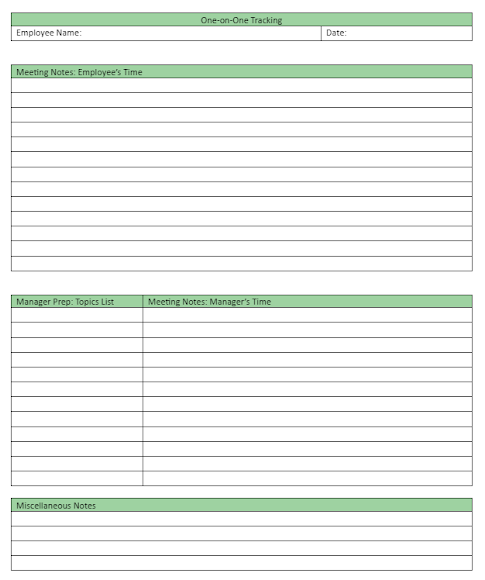
First is a document template. With this one, you would have a separate folder for each employee where you keep finished ones and blank copies of for future weeks. The biggest pro of the document version is its simplicity. The record-keeping document is the note-taking document you're using during the meeting. Afterward, you just put the filled-out sheet in the file and you're done.
The biggest con is after-the-fact recall. You have to manually leaf through pages of notes looking for whatever you need. When you're writing year-end performance reviews, for instance, the document version is far more time-consuming to compile the relevant information on each employee.
Here is a screen grab of what the document version looks like:
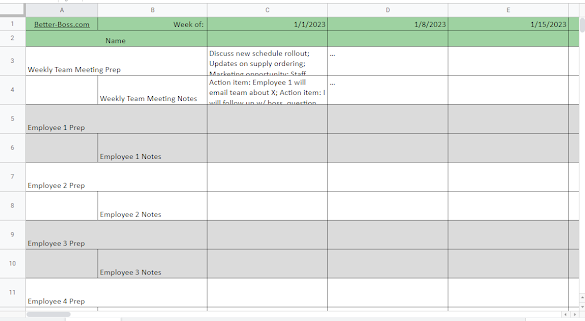
Next is the spreadsheet version. With this one, you have a single file for all employees (and your team meetings and your boss if you want). The employees go down the first column, and your dates go across the top row. The huge pro for the spreadsheet is organization. You can grab multiple weeks' of notes and easily scan through or control+f for keywords (e.g. "fb:"). The spreadsheet is also easier for planning topics several meetings out. For instance, you might assign a task with a due date two months out. It's super quick to toss a follow up note in the cell for meetings one month and two month down the road.
The major con is that each meeting requires a little more record-keeping work. Each week, you have to pull your prepped topics onto a notepad prior to the meeting, then take your hand-written notes from the meeting and type them up afterward. This is about 10 minutes of extra time that the document version doesn't require. (Though this work integrates pretty easily with the work 5 minutes before and after you should already be doing)
Here is a screen grab of what the spreadsheet version looks like:
Download these, modify them to your needs, and get a little better at your one-on-one record keeping. Enjoy!
Actions to take: Avoid giving the word "documentation" too much power in your mind. Keep accurate notes for all your work meetings. See the DOs and DON'Ts list below for more detail. When HR asks for documentation, compile the relevant notes with minimal exposition.
The first time most managers encounter the word "documentation," it is in reference to a poor performer. Things have gotten to a point where the manager needs to call up HR and talk about taking more serious steps. Before giving any recommendations, HR will always ask for evidence proving that the problem is serious, that it has continued for some time, and that the manager has attempted to address it through more informal means. "We'll need to see your documentation of the problem and the conversations you've had with the employee up to this point."
This context leads managers to dramatically misunderstand what "documentation" is. Imagine it. Your are dealing with a big issue. You've been hitting your head against it for months. The employee refuses to acknowledge their issue or make any kind of meaningful change. And the person you turn to for support says, "Prove that it's actually a problem, and prove that you've actually tried to do anything about it."
The natural reaction is to argue your case. Since it is a serious issue, you write up a multi-page memo explaining every detail of the issue, your conversations with the employee, your opinion on where this is headed, your opinion on the employee's mindset, etc. You want to absolutely convince your HR rep that it is time to take action, so you pour everything into this document.
You have just sunk your chances of moving forward with disciplinary or probationary action.
Documentation is just a record of your work. Nothing more, nothing less. When you hand HR something that "makes your case" about the situation, you are adding problematic elements. Stop thinking of documentation as some big, intense thing. Documentation is just notes. Anything you've written down is documentation. A sticky note with the line "Fb- missed deadline" stuck to a one-on-one sheet is documentation.
Now, there is a difference between good documentation and bad documentation. There is a difference between documentation that HR is satisfied with and documentation that is problematic for one reason or another. Documentation DOs and DON'Ts:
When HR asks for your documentation, simply compile the notes you have that are relevant to the issue at hand. At most, give a two-sentence explanation of what a note means if it is unclear. HR may want to go over these conversations with you in more detail, but they'll do it verbally. Follow this advice, and you will be much more likely to get meaningful support from HR to help with your problem employee.
Finally, remember that firing someone is never your goal. Termination is the result of a failure: the employee's failure to improve to an acceptable standard and your failure to help them improve. Feel disappointed about it, feel resigned to it, but if you ever feel eager to fire someone, check yourself.
Actions to take: Give far more positive feedback than negative feedback. A ratio to shoot for is 5-to-1, even with poor performers. Do not underestimate positive feedback's ability to successfully guide employee behavior.
Better-boss.com advocates for casual, frequent performance feedback using the following formula: 1) ask if you can provide feedback; 2) provide feedback using the format "when you do X, it has Y impact"; 3) finish with a question asking them to change or an affirmation that they should keep it up. Feedback is short, simple, and can be about any work behavior. All posts about feedback assume this formula and strategy.
Managers are problem-solvers. Those of us who don't come by it naturally get pushed into it. It makes sense why. We are imbued with the formal authority of the organization, so we make the call in tough situations. We carry over this mentality to most aspects of our work. We end up looking at our entire job as a series of "problems to be solved."
And when it comes to managing people, that's where we mess up. It is easy to focus on your employees' issues, the things that need to be fixed. You are in that problem-solving mode. The negatives are (often) the things that annoy you. The negatives are the things that other employees complain to you about. The negatives are things that might make you look bad to your boss.
Because we're in this mindset, it can be easy to find ourselves giving a lot of negative feedback. It takes time to come up with feedback to give our employees. When we're busy (and who isn't), we give feedback on whatever comes to mind first—usually, the problems.
Do not slip into this trap. Make sure you are finding time to give positive feedback. Much more positive feedback than negative feedback. If you need a goal to shoot for, 5-to-1 is often cited. Five times as much positive feedback as negative. It is fantastically important. Here are a few reasons why.
This is true, of course, for each individual piece of feedback. If you give feedback based on misinformation, you'll seriously undermine your credibility.
It is also true in aggregate. When you sum up all the feedback you've given an employee, it must paint an accurate picture of your employee's work. If it doesn't, you have failed just as much as if you gave a completely unfounded piece of feedback. Most people are doing most things well. Even your worst employees, frankly, are doing more things right than wrong. There is a reason that 50% is a failing grade in school.
Look at the feedback you've given over the past 6 months. When you review the sum of an employee's feedback, does it paint the picture of the employee that you know? If it doesn't look accurate to you, it doesn't feel accurate to your employees. They probably are not keeping a documented record of all the feedback you give them. But they have a sense for how often your feedback is positive and how often it is negative. 50-50 isn't good enough. After all, imagine if your boss thought you were only doing half of your work correctly.
I'm not talking about the feedback conversation itself. Positive or negative, giving feedback will take you less than a minute (when done correctly).
However, it is much easier to give positive feedback, and it is much easier to receive positive feedback. With corrective feedback, there is a great deal more self-management that needs to happen in the preparation. Is the wording purely factual and 100% accurate? Am I in a good mood? Am I prepared to keep my tone neutral? Am I prepared to stay sympathetic to the employee while talking about this thing that frustrates me? That 10 second feedback conversation might take you 10 minutes to mentally work yourself up to do.
The employee is going to have a similar mental journey after the fact. They will have the knee-jerk denial reaction. Then they will need to work through it and come out on the other side. You may be a perfect manager with a feather-light touch when it comes to feedback. You still can't fully erase the feeling that negative feedback means "you did something wrong." Your employee will take time process through it, and it will slow down other work.
Positive feedback doesn't require this time. People like receiving positive feedback, and most managers like (or like well enough) to give it. If you flub the wording a little, people will forgive in a way that they don't with negative feedback. Positive feedback generally doesn't require you to self-monitor your emotions or tone. After the fact, the employee may continue thinking about it, but not in a way that distracts them from other work.
At one of my jobs, every manager had to submit a monthly report of their activities and the activities of their department: highlights, important milestones, issues faced, that sort of thing. Early on, I poured a lot of work into these. I prided myself on giving my boss an accurate picture of both the successes and the challenges I was facing. She never mentioned the reports. As months went by, I spent less time on them, just doing enough to call it finished. After about 18 months, I stopped submitting them altogether. She never mentioned the reports. I was promoted, and she no longer supervised me. Only then did she say, "You know, I was pretty surprised when you stopped submitting your monthly reports. They really helped me know what was going on, and they're technically required. Other than that, your work was great."
As I've said elsewhere in this blog: work that is not communicated is not finished. That goes for managers too. It is not enough to notice your employees' work. You must tell them you noticed, or they will assume that work isn't important. We're all busy. We don't have time to waste on unimportant things. Just like I stopped doing those reports, your employees will stop (or minimize their time on) work that isn't getting them positive feedback.
Positive feedback provides more guidance than we give it credit for. We fall into the trap of thinking that negative feedback is the "real" way to guide employees toward more effective work. We give positive feedback to sort of "pay our due" for giving negative.
That thinking is totally inaccurate. In fact, aside from egregious errors, it is possible to successfully guide your employees' work using only positive feedback. If you've got an employee that shows up late sometimes, give positive feedback when they're on time. If you've got an employee that misses details, give positive feedback when they get the nuances right. Positive feedback literally tells employees, "Do more of this." Do not trick yourself into thinking that it is just praise.
To be a truly effective boss, the most important thing you can do is build a trusting relationship with each employee. By far the easiest way to do that is through routine one-on-one meetings. Better-boss.com recommends that those meetings are scheduled, 30 minutes, weekly, and rarely missed, with the first half of the meeting spent on whatever they want to discuss and the second half for whatever you want to discuss. All posts about one-on-ones assume this strategy.
A 30-minute meeting is 1.25% of your time, assuming you work 40 hours per week. It is a drop in the bucket. Nevertheless, there are a great many organizations where a weekly one-on-one with your employees would be considered an absurd proposition. Here are three of the most common arguments people use to resist one-on-ones.
Whether you work in a highly functional organization or a dysfunctional one, there is too much work for the number of hours. We don't have time for a meeting every single week with no specific agenda or goal, just to "build the relationship." It's absurd to imagine.
My favorite version of this argument is that you, manager, don't have time for weekly one-on-ones. You've got 15 employees for goodness sake! That's 7.5 hours of your week, gone!! How can you possibly justify all that time spent?
This argument is a lot of fun to challenge. Simply pull up notes from past a one-on-one and talk through each topic. Ask the nay-sayer "Was this one worth taking a few minutes to talk through? How about this one? And this one?..." Then go to the very next week with the very same employee. Invariably, they agree that there is no problem spending a few minutes on each individual topic. They agree that covering these details is highly relevant to helping the employee complete their work (therefore the conversation itself is part of "their work"). Then put the final nail in the coffin: this is a 30-minute meeting. A well-oiled weekly one-on-one will cover 8-10 topics a week for most fulltime employees. It is impossible to claim that 8-10 individual conversations would be more effective than getting it all sorted in a single 30-minute meeting.
The manager version of this argument is even more fun to respond to. What is the point of a manager, anyway? To make sure that the work gets done in a timely and effective fashion, right? To direct others' work, give feedback, coach them through any complexities they face, ensure changes are implemented smoothly, develop their abilities, check in on status of projects, etc. etc. Again, just turn to past one-on-one notes. Point out examples where all of this is happening every week under this management strategy. Challenge the nay-sayer to produce evidence that other managers are getting anywhere near this amount of managerial work done. (Bonus: we can also talk about outcomes. How is my department achieving goals relative to others? How many personnel issues come out of my department relative to others? How well do changes get implemented in my department relative to others?)
As the argument goes, the employee and the manager could never have a meaningful conversation if they are locked in a scheduled, private meeting together. This feeling comes from all over the organization: the employee, the higher-ups, or the manager themselves. You might have this concern. You picture "calling the employee in" for a meeting versus just walking up to their desk to have a chat. Obviously, you think, the latter is going to lead to a more relaxed conversation.
Our intuition tells us that line of thinking is correct. Empirically, it is simply wrong. First, employees never have completely relaxed conversations with their boss. Walking up to their desk to chat may feel casual to you. To them, it is an alarm bell as they mentally scramble to shift gears and try to anticipate whatever it is that you want ("Was I slacking off? Did I forget to do something? Is this going to take two minutes or twenty?" etc.).
Actually do weekly one-on-ones for a few months as this blog recommends rather than just imagining them in your head. When it comes to formality and employees keeping their guard up, you will see that the opposite is true. The weekly one-on-one is a rare opportunity for the employee to let the professional mask slip a bit and relax into their real self. Assuming, of course, you genuinely make the meetings about the relationship, genuinely spend half the meeting (or more) on whatever is important to them, genuinely reward their candor and show candor yourself.
This argument usually comes from an employee, and usually a tenured one. They've had a lot of ineffectual bosses who don't do much more than get in their way (though the employee would never say it that way). They'll assure you that, while the one-on-one is likely a wonderful thing for some employees, they are doing just fine. They know how to do their job. There's really nothing to discuss.
This argument is a polite way of saying, "I don't need to be managed." Average bosses find themselves giving into this argument because, put bluntly, they really can't figure out what they have to offer these employees.
Do not let anyone tell you that your employees don't need to be managed. Even the highest achieving employees benefit enormously from regular check-ins with their boss. Let's imagine an extreme version of the situation: it is the perfect employee and you as boss have literally no guidance you can offer. The weekly one-on-one is nothing more than them letting you know the things they are doing and you letting them know they are on the right track.
This perfect-employee circumstance doesn't exist. But if it did, the one-on-one is still absolutely worth the time. Think about the benefits that are coming from even this stripped-down version of the meeting. The employee knows for certain that the boss supports their work. If things start to get scrutinized by higher-ups or other departments, they can say the boss has approved it. The employee's work is more effective because they can more forward quickly and with confidence. The boss knows what the employee is up to. They might hear of similar initiatives across the organization and be able to expand the employee's work and recognition—or even just do this in-department with other employees. The employee's work is more effective because it can be tied into departmental, organizational, or other employees' goals.
All of these arguments come from the same place. People make assumptions about how your weekly one-on-ones will go based on their (poor) past experience. Better bosses are constantly fighting the ghosts of average bosses. When you meet resistance to your one-on-ones plan, don't let it get to you, and don't let it convince you. Be prepared to calmly respond, explain their value, and be firm in your certainty that weekly one-on-ones are the single most effective way to manage your team.
Actions to take: When crisis hits, do more communicating, not less. Do not allow your employees to set the tone of your communication relationship—the impulse will be to avoid conversation. Instead, redouble your efforts to check in frequently and keep them updated. When changes occur, stick to Announce Before you Implement, though likely at an accelerated pace.
In challenging
times, people tend to clam up. We are a self-preserving bunch. We want to
protect ourselves from danger. That instinct can go unnoticed when times are good,
but it becomes abundantly obvious when times are tough. Speaking your mind is a vulnerable thing to do. When there is
a crisis, whether it is a global pandemic, recession, or something
negatively impacting your particular place of work, your staff will avoid
putting themselves out there. That means they will be a lot less vocal about
their thoughts, concerns, and good ideas for how to pull through.
When things are tough, you need just the opposite. We need clever ideas from staff. We need to hear concerns about aspects of the plan we hadn't considered. We need to know how well people are managing their emotions and when they need a break. Even though we know this, we don’t act like it. Our team is apt to do less communicating. When everything feels up in the air, people will be giving off the signal, “Leave me alone with my thoughts.” There is social pressure to give people what they want. It is especially present when times are tough. With everything going on, the least we can do is let them be, right?
We must overcome that social pressure. The fact is, that is not what people really
want. More than anything, people in crisis want to reduce uncertainty. When
times are truly challenging, you will hear things like, “I don’t even care what
will happen next, I just want to know.” Leaving people to stew in their
thoughts is the last thing you need. Hopefully, this thought appeals to both
the people-oriented readers and the business-minded. It is both good for the
person and good for the organization to stop employees from endless rumination.
We’ve established that people will start pulling back. Instead of letting them set the communication lead, you must set it. Things aren’t normal, and there is likely to be a new standard of communication. It could swing one way (less talking, drop our usual routine of one-on-ones, put our heads down) or the other (more communicating, getting even more candid about our concerns, touching base more frequently to get questions out in the open).
You have the opportunity to
set the new normal. Stop by your employees’ desks daily. If you are virtual,
set up a daily phone call to say good morning and see what is on their minds. Update them on whatever
you’ve learned in the past 24 hours. Update them even if you have no new
information: “You know that thing we were talking about 2 days ago? I
haven’t heard back yet from my boss, but I’m going to keep pinging her about it
until we know what’s up.” Have some questions for them. Try to draw out their
worries. Get a sense for how secure or insecure they are feeling. It will
change day-by-day and week-by-week. You need to know at any given moment where
each of your staff stand. That way, you have a sense of how they are going to react
when the next change comes, and it inevitably will.
Speaking of changes, how is managing change different during a crisis? The answer: it is the same, just faster. In the Announce Before you Implement post, we outlined how people react to change and the best process for making change as smooth as possible. All of that still applies. It’s just that now, everyone is on their last nerve and you have less time to work through thoughts and feelings. Do the same ABI process to the extent that you can:
In a crisis, there are times when you will have to do it all in a single day. It might look like this:
I recommend
doing this even if the change already happened. You might find out on
Tuesday that “effective Monday, we were supposed to switch to X method.” Fine.
Not ideal, but fine. Still take the time to go through the ABI process. Even if
the time between step 1 and step 2 is 30 minutes, give your team that 30
minutes to think about the change. Pick a “go live” time for your team, even if
it’s just a few hours later. (Yes, I am telling you to be a little delinquent
here. You’re a manager, and that means you get to pick what you’re in trouble
for. I’d rather be in trouble for being a few hours late than for being
ineffective.) In addition, address the elephant in the room: we have
technically been doing it wrong based on this new communication. Make it
equally clear that, in your eyes, the team is not at fault.
If you follow this process with confidence, your employees with see you as a bastion of stability. They will see that it is really not so complicated to swim with the changing tide (or whatever metaphor you prefer).
This is, of course, not meant to be a comprehensive plan to managing during stressful change. It is a quick reminder for what needs to be most present in your mind during times of upheaval.
Note from the author: if you enjoy this blog, please consider sharing your favorite posts with others.
